Read the original story here:http://latimesblogs.latimes.com/jacketcopy/2009/02/a-different-lig.html
Wednesday, February 25, 2009
Someone needs to update their archives
Read the original story here:http://latimesblogs.latimes.com/jacketcopy/2009/02/a-different-lig.html
Labels:
A Different Light Bookstore,
bookstores,
GLBTQ books
Monday, February 16, 2009
Pebbles
Our discussion of Jeanette's brown pebble has sent me off searching for more. I'm starting a collection. One that comes quickly to mind, belongs to a poet Jeanette's mother might have known, at least in his hymns. This, for instance, sounds very much like Mum's cup of blood, no?
"There is a fountain fill'd with blood
Drawn from EMMANUEL's veins;
And sinners, plung'd beneath that flood,
Lose all their guilty stains."
Olney Hymns (1779)--'Praise for the Fountain Opened'
William Cowper (26 November 1731 – 25 April 1800) was an unhappy man who turned to evangelical Christianity, poetry and the company of good women to save himself from suicide. But don't be put off. Cowper also reinvented English poetry by writing of daily experience, celebrating the glory of God's creation, by writing beautifully about his own patch of nature, even writing perhaps the sweetest poem ever in memory of a favorite bunny, "epitaph on a hare."
Cowper's pebble is found in the following line, which might have been written about Jeanette in Oranges Are Not the Only Fruit. See if you don't see much of the girl evangelist's struggle summed up in these two lines:
“Nor sword nor spear the stripling took,
But chose a pebble from the brook.”
This from Cowper's poem: Jehovah-Nissi. The Lord My Banner, which is based on Exodus, xvii.15. Here's the whole first stanza:
"By whom was David taught
To aim the deadly blow,
When he Goliath fought,
And laid the Gittite low?
Nor sword nor spear the stripling took,
But chose a pebble from the brook."
(So, British slang fans, might not the Gittite be a possible origin for the put-down "git?")
Any other pebbles from literature to match the one Jeanette keeps in his pocket? Stay tuned.
Monday, February 9, 2009
"Are You Saved?"
Okay, everybody not going to Hell because you've been "saved," now is the moment for us to help all these poor, damned heathens to better understand Oranges Are Not the Only Fruit. At the last meeting, there was some confusion about the Biblical chapter headings. Rather than just blabbing away about this myself -- as if I knew any better than the rest of you -- why not bring a Bible, if you've got one, and I know some of us do, if only as souvenirs, and see if anyone can spot check some of the references in the text for us?
Another suggestion to think about: instead of looking for literal correlations between each chapter in the book and The Chapter in The Book that give the novel it's chapter titles, why not think about and try to talk about what if anything those words, Leviticus, Numbers, etc., might have meant to us when we were good little Christian children ourselves? Anybody remember Judges as a child? Anybody mistake The Seventh Seal the way Jeanette does in the novel? Remember any similar confusions about that very confusing object called The Holy Bible?
Also, try to remember what Church felt like before you even began to understand what any of it meant. Did you enjoy it? Did you like the singing? The preaching? What?
And when, like Jeanette in the book, you began to feel stirrings of "unnatural passions," was religion one of the ways you sought to explain those feelings? Did religion give you any answers? Are those answers still applicable to your adult life?
Do you still believe as you did when you were a child?
One last question, did any other stories, faerie stories, The Brothers Grimm, have particular reality for you when you were a child? Was, say, Dorothy in The Wizard of Oz, any less real to you than Moses or Jesus or God The Father? Did you ever get any of that mixed up? I mean, don't the Wizard of Oz and God the Father look a little alike in your memory, or is that just me?
Post your answers in Comments here, or ponder them for the next meeting.
What's In Your Cigar Box?
Think of a cigar box. Remember the opening credits of the film of Harper Lee's To Kill a Mockingbird? Scout keeps her treasures in a cigar box. Remember the soap doll? The broken pocket watch? Remember how invested those objects are with special meaning after one learns where they came from, who gave them to Scout? Okay. Now keep that cigar box in mind. We'll come back to it in a minute.
When we read Jeanette Winterson, particularly for the first time, it is all too easy to want to turn to contemporary literary criticism and theory to explain and incorporate the less familiar elements of her technique. Looking for help, we're likely to encounter all sorts of perfectly legitimate, and perfectly useless -- at least for the purposes of our Book Club discussions -- critical jargon about "metafictional explorations" and "post modernist tropes" and the like. All of that tangle is meant to place Winterson within a critical, rather than a literary tradition. Think of it as the difference between enjoying a concert of serious music and learning music theory. One doesn't need the latter to enjoy the former, right? I'm not saying that what is in the critics' analysis of Winterson's work is not true, I'm just suggesting that as readers, as opposed to academics or critics, it doesn't help us much in our conversation, or enjoy the book more, does it?
Instead, I would suggest that rather than trying to understand or explain away the elements of Oranges Are Not the Only Fruit that do not conform to more traditional, familiar narrative techniques (plot, character development revealed through the action of the story and over time, dialogue,) though Winterson does use all of these things, we try an experiment.
Remember that cigar box? Try to remember what it was to be a child. What mattered to you? What objects did you value? What did you treasure? Now. Other than Nick, I don't know that any of us grew up to become novelists, but if we had, mightn't our talisman be not so much a soap doll, or a pocket watch, but the stories we told ourselves as children? All children fantasize and play. All children tell stories. Now, imagine yourself in the home described in the novel. What toys does Jeanette have? Does she watch television? Does she go to the movies? Does she have friends her own age? When does she finally make a friend not an adult? What would Jeanette have in her cigar box? What would Jeanette treasure? With what does Jeanette play?
And think also about the books Jeanette either has read to her or eventually reads for herself. Other than Jane Eyre and the Bible, what is the first book we're told Jeanette read?
I don't mean this to be a riddle or a quiz. I'm just trying to suggest, for anyone for whom this kind of fiction is either a new experience or an unfamiliar one, that what might help most in discussing this particular novel is to try to experience it not as we might another, more straight forward book, but as if our own childhood experience was being explored at the same time as we experience Jeanette's. Remember, the rules for one child telling another child a story are different from the stories adults tell children, and even from the stories children tell adults. So. How does Jeanette tell us her story? How does she tell us not only the events of her childhood, but their meaning to her at the time? What points of reference does she have, what kind of stories would she know? What are the tools this girl has to explore her emotions, her growing maturity, her religious training, her sense of humor?
What makes Winterson such a brilliant and challenging novelist isn't that she applies particular theories or narrative strategies to her books, though obviously she does do all that quite self-consciously, but that she succeeds in recreating both the sense and the feeling of this childhood, quite possibly her own, without the intrusion of what I'd ask you to think of as the Narrative Nanny. This would be the reassuring presence of the adult voice, either in the third person of an anonymous narrator, or the adult narrator commenting retrospectively on the state of mind and the state of events in the life of the Jeanette in the book. Again, think of Harper Lee's Scout, the adult Scout who regularly appears in the narrative to first reassure us that Scout survives and learns from her experience and turns out just fine, and second, tells us what we need to know about what is happening even if Scout can't possibly appreciate the larger implications at the time. This is how we are used to reading about childhood. Harper Lee writes to this model exceptionally well. We do not question Scout's reality as a child, and we do not question that she has appropriate adult supervision in the telling of the events of "that summer." But who's looking out for Jeanette? What Winterson may be doing is doing away with this convention all together. The novelist Jeanette lets the child Jeanette tell her story any damned way she chooses, or seems to. To put that another way, the novelist Jeanette Winterson, quite slyly, refuses us the comfort of commenting directly on what the Jeanette in the novel chooses to tell us and when and how she does so. This can be uncomfortable, but it need not be confusing or frightening. We know Jeanette will survive, don't we? Besides the obvious reassurance of having the novel itself as proof that Jeanette Winterson survived her childhood, what other clues do we have that the novel's Jeanette is a survivor? What does she use to survive? What do her stories tell us? And how much do you love the way this kid's mind works?
I'd ask everybody in the group to try the cigar box exercise and think of the objects, the books and the stories and the treasures we all had as children. Bring those with you to the group, if not physically, then mentally or as a list. What were the tools you used as a child to explain and explore your place in the world? How did you tell your own story? Where was the magic for you?
Saturday, February 7, 2009
Another Loss
When I was a teenager, a friend and I went to New York City for the first time. One of the first places we went was to the Oscar Wilde Memorial Bookstore. She bought a button that read "A woman without a man is like a fish without a bicycle," and I bought a Tshirt that had the word "faggot" in small and handsome cursive over the left breast. We also bought books, stickers, little flags... who knows what all?
Wearing that Tshirt as a freshman in a small town high school got me put in a trashcan and rolled down a hall. It was still worth it -- we were not alone, we belonged to a community, we had our own bookstore!
The owner of the Oscar Wilde Memorial Bookstore announced on February 6th that, after 41 years, the store will close for good by March 29th of this year.
As citizens of Seattle, we've already watched our own GLBTQ bookstore close. Women's bookstores, gay & lesbian bookstores, independent bookstores have been disappearing for the past decade or more. And what, if anything will replace them? Connecting here on the Internet is all well and good, but we are losing our actual cultural institutions, our meeting places, our communities.
Remember, GLBTQ books didn't come into being as a viable part of publishing because the demand was so great, our books came to be our books because we as a community demanded a place of our own; in literature, in publishing, in media, in retail.
Neglect the institutions that taught us how to be and we'll be back to being nowhere, just so many strangers passing along the dark halls on Manhunt, meeting one another in tired bars, learning who we are, and what we might be, not from our community and our ancestors, but on the school yard, and from our enemies.
Is that the future we want?
Meanwhile, our hearts go out to the good people at the Oscar Wilde Memorial Bookstore. Thanks again for my life.
Thursday, February 5, 2009
Additional Reading
Do you know Cold Comfort Farm, by Stella Gibbons, published in 1932 and made into a very good movie in 1995? It is a delicious spoof of a British country Gothic, still quite popular at the time of the novel's original publication, usually involving some innocent sent down to stay with mad relatives with.. a... dark... secret.
"I saw something nasty in the woodshed." repeats Aunt Ida Starkadder, again and again.
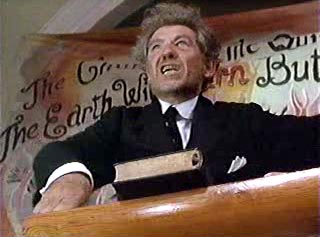
Pictured is our own Sir Ian McKellen as Amos Starkadder,-- "Ye're all damned!" -- one of the mad Starkadders at Cold Comfort Farm. Amos is a preacher for the Church of the Quivering Brethren, and it is this that made me think of the book and the film as a suggestion for further, fun reading. Poor Jeanette's Mother would be right at home among the Quivering Brethren, though I don't doubt she'd soon give them a good reason of her own for all that carrying on in Church.
Check it out.
Wednesday, February 4, 2009
Mrs. Beeton: Everything Proper
If Nell Gwynn is the spirit and symbol of Restoration disorder; sensual, bawdy, bright and buxom,the Queen of the English counter-reformation, then Mrs. Beeton is the Victorian Lady Triumphant, the ne plus ultra of the Puritan counter-counter-reformation. She wrote the manual for housewives that taught generations of bourgeois women not only how and what to cook, but how to clean, hire and fire servants, raise "proper" children, serve God and be (wait for it) respectable.
There was a fun BBC TV movie shown on PBS last year (?) about this lady, "The Secret Life of Mrs. Beeton." It's available to rent.
There is also a very thorough biography (would she want any other kind?) called The Short Life and Long Times of Mrs. Beeton, by Kathryn Hughes, though it is sadly only available in a British edition. (Look for used copies on www.abebooks.com.)
Tonight's Meeting Was Terribly, Terribly Good, Doncha Know.
Thanks to everybody at tonight's meeting! I thought it was an exciting start to our February reading; ideas, laughter, Biblical exegesis, potato chips, quotation, history, Testimony, Witness, giggles...
Just a reminder, anyone who's of a mind to ask questions before our next, or who just wants to share a thought, drop me an email or comment freely here.
See everybody next week -- tell a friend.
Meanwhile, I'll be waiting to hear from you.
Just a reminder, anyone who's of a mind to ask questions before our next, or who just wants to share a thought, drop me an email or comment freely here.
See everybody next week -- tell a friend.
Meanwhile, I'll be waiting to hear from you.
Mrs. Beeton's Marmalade
Mrs Beetons Jams and Preserves Revisited
Orange Marmalade
Equal Weight of Caster Sugar and Seville Oranges
To 12 Oranges allow:
600ml (1 pint) Water
Peel the oranges carefully, remove a little of the white pith.
Boil the rinds in water 2 hours, changing the water three times to take off a little of the bitter taste.
Break the pulp into small pieces, take out all the pips and cut the boiled rind into strips.
Make a syrup with the sugar and water.
Boil it well, skim it and when clear, put in the pulp and strips.
Boil all together from 20 to 30 minutes.
Pour into sterilised jars.
Allow to cool and cover with airtight lids.
Store in a dry place.
The juice and grated rind of 2 lemons to every 12 oranges, added with the pulp and chips to the syrup, are a very great improvement to this marmalade.
Time: 2 hours to boil the orange rinds. 10 minutes to boil the syrup. 20 minutes to 30 minutes to boil the marmalade.
Seasonable: This should be made in March or April, as Seville oranges are then in perfection.
ORANGE MARMALADE
1566. INGREDIENTS - Equal weight of fine loaf sugar and Seville oranges; to 12 oranges allow 1 pint of water.
Mode - Let there be an equal weight of loaf sugar and Seville oranges, and allow the above proportion of water to every dozen oranges. Peel them carefully, remove a little of the white pith, and boil the rinds in water 2 hours, changing the water three times to take off a little of the bitter taste. Break the pulp into small pieces, take out all the pips, and cut the boiled rind into chips. Make a syrup with the sugar and water; boil this well, skim it, and, when clear, put in the pulp and chips. Boil all together from 20 minutes to 1/2 hour; pour it into pots, and, when cold, cover down with bladders or tissue-paper brushed over on both sides with the white of an egg. The juice and grated rind of 2 lemons to every dozen of oranges, added with the pulp and chips to the syrup, are a very great improvement to this marmalade.
Time - 2 hours to boil the orange-rinds; 10 minutes to boil the syrup; 20 minutes to 1/2 hour to boil the marmalade.
Average cost, from 6d. to 8d. per lb. pot.
Seasonable - This should be made in March or April, as Seville oranges are then in perfection.
Nell Gwynn
Dear ol' Nell Gwynn, quoted for the title, "Oranges are not the only fruit", was an actress and the mistress of Charles II. There are excellent biographies available, including the recent and well reviewed Nell Gwyn: Mistress to a King, by Charles Beauclerk. Nell was a hoot as well as a self professed "whore" and a genuinely good soul. She rose from the ditch her mother was said to have died in to become a powerful and popular political figure, as well the Spirit of Her Age; irreverent, greedy, generous, spendthrift, hilarious, sexy and one Hell of a good time. That she was disinclined to be docile, to say the least, may well be what made her so attractive a figure with which to kick off the novel. Well worth further reading.
If I can find the context for the title quote, I'll post it here.
Tuesday, February 3, 2009
Another Food Note
The "black peas" that Jeanette collects from the gypsy caravan for her mother are pigeon peas, cajanus cajun, in fancy Latin, and are a traditional Lancashire dish, and sold at carnivals -- thus the encounter with the gypsy fortune teller who tells Jeanette she will never marry, etc.
First Jeanette Winterson Question from the Text... ?
Q: Toast soldiers?
A: Thin slices of toast, cut for dipping into one's soft boiled egg.
How to Make Perfect Toast Soldiers:
"There has always been a danger of cutting your soldiers too fat or too thin. If they are too fat then obviously they can't fit into the opened neck of the egg which is infuriating.
"But if the soldiers are too small then there's the risk of a catastrophic failure after they're dunked into the yolk. The simple act of withdrawing the soldier may cause it to break in half, forcing the person who is eating the egg to resort to a teaspoon."
Saturday, January 31, 2009
Nick's Notes
Jeanette Winterson
ORANGES ARE NOT THE ONLY FRUIT
GENESIS
Setting: Lancashire. “ Sunday was the Lord’s Day…” The radio program, World Service. Sunday afternoon walks with mother and dog. The story of her mother’s conversion. Mother adopted Jeanette from an orphanage. Pastor Finch finds Jeanette having the lions eat Daniel in Fuzzy Felt. The walk home after church with her aunts, stopping in Arkwright’s For Vermin. Mother receives official letter insisting Jeanette go to school.
3 MOTHER, the narrator’s adoptive mother, known as the Jesus Belle for her conversion attempts in pubs, 36
3 FATHER, formerly a gambler till he married and found the Lord, 36
3 NEXT DOOR, 13, has another baby, 38
5 MAXI BALL, owns a warehouse of cheap clothes called Maxi Ball’s Catalogue Seconds
6 ELLISON, owns a tenement where there’s a fair once a year
7 GYPSY who says “You’ll never marry”
7 GRIMSBY, an alternate paper shop to the one owned by two women
7 MRS WHITE, Mother’s chum, 11, 17, 23, has a vision, 40
8 PASTOR SPRATT, a healer on his Glory Crusade, 21, 24, one of the most famous and successful missionaries their churches ever sent out, his exhibition called “Saved by Grace Alone,” 34
9 UNCLE WILL, an actor who died a pauper
9 THE FIRST FAIRY TALE: The sensitive princess and the old hunchback in the forest who wishes to die
11 PASTOR ROY FINCH, zealot visiting speaker from Stockport, visiting on his regional tour, 83
12 MRS GRACE FINCH
12 MRS ROTHWELL, deaf, falls over, 85, so engrossed communing with the Spirit that she doesn’t see the tide come in, 117
13 JEANETTE, narrator, age “fourteen if she’s a day,” 77
13 MRS JEWSBURY, plays the oboe and conducts the choir, 25, makes love to Jeanette, 106, living in Leeds with another woman, 132
13 AUNTIE ALICE
13 AUNTIE MAY, 22, her gallstones, 28, with Ida, 77
14 MRS ARKWRIGHT, runs Arkwright’s For Vermin, 60, staggering out of the pub, 133
EXODUS
Mother getting Jeanette ready for her first day of school. Jeanette goes deaf for three months with her adonoids, and word spreads through the church that she’s in rapture. Miss Jewsbury takes Jeanette to the Victoria Hospital where she has an operation on her ears, and Elsie visits her. Elsie’s gift of three mice, and her disquisition on the two worlds. A school trip to Chester Zoo. The action kit for the Second Coming. Flags made by disabled missionaries. Mother’s old flames, including Pierre. The miseries of being dinner monitor. Jeanette’s essay, “What I Did in my Summer Holidays.” Tormented by the other classmates for being different. Mrs Vole has to talk to Jeanette. Jeanette submits her black-and-white sampler for the needlework class Prizegiving. The hyacinth contest. The Easter egg painting competition: Jeanette re-creates Wagner in eggs.
23 ELSIE NORRIS, with numerology, no teeth, 29, plays the accordion, 38, told Mrs Jewsbury about Jeanette, her first time back to church after her long spell in hospital, 132, her death, 151
25 AUNTIE BETTY, in the hospital, her leg loose, 26, gets sunstroke, 38
24 refs to oranges, 26, 27, 28, the only fruit, 29, 39, 113, 172
34 SUSAN GREEN, from a very poor family
34 SHELLEY
34 STANLEY FARMER, slipped into the pond, plays Joseph, 41
34 MRS VIRTUE, helping Shelley finish her summer party dress, collecting samplers, unable to see what’s out of context, 44
36 PIERRE, Mother’s early temptation, now listed as an “old flame,” the second reference to him, lives in Wigan, 56, mother met him in Paris, 87
36 MAD PERCY
36 EDDY
36 EDDY’S SISTER, whose picture promptly disappears
39 MRS SPARROW
39 MRS SPENCER
40 MRS VOLE, the head
43 SUSAN HUNT, nearly strangled by Jeanette to illustrate the fate of the damned
49 THE SECOND FAIRY TALE: The Emperor Tetrahedron and the revolving circus of midgets
49 “…no emotion is the final one.”
LEVITICUS
Hymns on the piano to drown out Next Door fornicating on a Sunday morning. Mother becomes active in the Society. Mother’s friend who makes wreaths. Working with the undertaker. Planning the Society’s special annual conference in town.
56 ELI BONE of the Society of the Lost, in Wigan
56 MRS MAUDE BUTLER, former treasurer to the Society
61 THE THIRD FAIRY TALE: The prince who searched for a perfect wife, and the perfect woman in the forest who refuses to marry him.
NUMBERS
The dream of being married to a pig. Men as beasts. Jeanette discovers the real ending to Jane Eyre. Hiding in the dustbin to eavesdrop on women talking about their men. Aunt May and forbidden Ida. Mother buys Jeanette a dreadful new pink mac. Jeanette meets Melanie boning kippers behind the fish stall, offers her a baked potato, and invites her to church, where Melanie raises her hand as a sinner. Mother tells her of her fall from grace with Pierre. Jeanette stays overnight with Melanie.
72 UNCLE BILL, horrible and hairy, 73
75 NELLIE, a widow on hard times since Bert died, blind 118
75 DOREEN
75 BERT, Nellie’s dead husband
75 FRANK, Doreen’s husband, up to no good
76 HILDA, across the road whose husband drinks
76 JANE, Doreen’s daughter, age seventeen
76 SUSAN, Jane’s friend, where Jane spends all her time
77 IDA, one of the women who runs the forbidden paper shop
77 LOUIE, Jeanette’s mother’s name
78 MRS DOREEN CLIFTON, who gives singing lessons, shops at Marks and Spencers, Marks and Sparks, 81, says Jeanette needs a new mac, 81
80 MELANIE, boning kippers on the other side of the stall
81 MONA
82 MRS BETTY GRIMSDITCH, the waitress at Trickett’s, 81, 169
85 DANNY, plays the guitar in church
86 ALICE
86 GRAHAM, a newish convert boy at church
DEUTERONOMY
The last book of the law
On storytelling and history, disposing of the past and collecting curios, the flexibility of the past and the balance of stories.
95 “If you want to keep your own teeth, make your own sandwiches.”
JOSHUA
Mrs White and mother clean the parlor. The Awful Occasion when Jeanette’s real mother comes to see her and is driven away by mother. Jeanette trustingly tells her mother of her love for Melanie. In church, the two girls are caught by surprise; Mother has told the pastor, and they are singled out as under Satan’s spell. Jeanette refuses to recant. Mrs Jewsbury sees Jeanette to her home and makes lover to her. A full day at home with the pastor. Jeanette locked in her room without food. Dialogue with the orange demon. Jeanette repents. Melanie has been sent to Halifax. Jeanette goes to her. Fever dream. Mother burns Jeanette’s letters in the back yard. Glandular fever. The demon in the orange. Five angry men from the boarding house complain about the singing and tambourines of the revival meeting. Rehearsing Christmas cdarols with the Salvation Army. Melanie comes to say goodbye on the Sunday of the Nativity play. An uncompli-cated love affair with Katy. Spitting at Melanie’s fiancĂ©e.
116 KATY, newly converted in the summer, coming to church, 120
117 FRED, the hired bus driver
128 THE FOURTH FAIRY TALE: Sir Perceval, the decay of Camelot, and his dream of the Holy Grail. * Sir Perceval arrives at the dwarf’s castle. * The two different hands of Sir Perceval.
JUDGES
Jeanette and Katy leave the door unlocked in the guest house. The issue of allowing men power in the church. Jeanette announces to her mother and the pastor that she’s leaving the church and refuses to repent. Mother orders her to leave. Jeanette’s last morning at home.
RUTH
Jeanette returns to work at Elysium Fields funeral parlor. Driving the ice cream van, she discovers that Elsie has died. Jeanette’s farewell to Elsie in the funeral parlor. When Jeanette’s mother and relatives realize she’s working with the funeral parlor, they leave Elsie’s reception in outrage. Mrs Jewsbury visits. “When did you last see your mother?” Snow on the train line. Jeanette goes back to see her mother at Christmas. Mrs Arkwright takes Jeanette for a drink, and confides her plan to burn down her own shop. Accidental meeting with Melanie pushing a pram. Mother in headphones, receiving reports.
141 THE FIFTH FAIRY TALE: the tale of Winnet Stonejar, sorcerer’s apprentice:
The sorcerer lures Winnet Stonejar across the stream. She lives in his castle, and becomes convinced he’s her father. The sorcerer calls for the unknown boy who loves Winnet to be cast out of the village, and then drives out Winnet. The raven Abednego can’t go with her because its heart is stone. * Winnet decides to make her way to the beautiful ancient city guarded by tigers. * Winnet learns boat-building and leaves the village.
148 THE WOMAN who owns Elysium Fields funeral parlor
148 JOE, her friend
149 BIRTWISTLE, age eighty, owner of the last horse-drawn ice-cream cart
164 REV. BONE, a broken man
170 “I miss God. I miss the company of someone utterly loyal. I still don’t think of God as my betrayer. The servants of God, yes, but servants by their very nature betray. I miss God who was my friend. I don’t even know if God exists, but I do know that if God is your emotional role model, very few human relationships will match up to it.”
171 “…there are different kinds of infidelity, but betrayal is betrayal wherever you find it. By betrayal, I mean promising to be on your side, then being on somebody else’s.”
172 The title – “oranges are not the only fruit” – said by the mother
Thursday, January 29, 2009
Next up, Jeanette Winterson!
Like most people I lived for a long time with my mother and father.
My father liked to watch the wrestling. My mother liked to wrestle.
This is the story of Jeanette, adopted by working-class evangelists in the North of England, in the 1960's. You've just got to read it. You will laugh, you will cry, you will cringe, and you will have a blast discussing this rich and rewarding book.
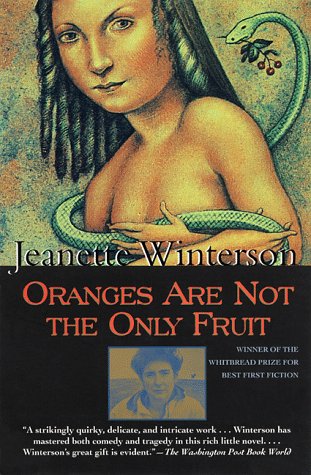
If you've never read Jeanette Winterson, or if you're already a fan, please be sure to come join us every Wednesday at 6PM in February as we read and discuss her amazing autobiographical novel, Oranges Are Not the Only Fruit!
Winterson is a literary powerhouse, regularly producing novels and essays that challenge even as they entertain readers around the world. She is an amazingly inventive writer and a literary stylist of the first rank.
Where you raised in a house like this one?
Do you remember your first love?
Have you seen the BBC film adaptation?
Oranges Are Not the Only Fruit in February!
Wednesday, January 28, 2009
Why We're Here
I'm going to be writing on this new blog regularly. It's my furry mug in the snapshot under "About Me." If you're at all curious about who I am, let me just say I was, in a manner of speaking, the first member to sign on with this new Book Club. How could I not?
I've been reading Gay & Lesbian literature since roughly the time that we collectively decided that we, as a people, did indeed have a literature, a culture and a voice. I wasn't present when our Movement was born. I wasn't reading One Magazine or The Ladder back in the day. I am of the generation that came of age after, and because of, the work of the pioneers who wrote and marched and organized and bled and died to make Stonewall. I kissed Harry Hay at the 1987 March on Washington, but that was as close as I ever got to calling him Comrade.
My generation inherited not only the struggle and Pride of our ancestors, we also received from the them, and from those who they first empowered, an astonishing legacy of art, poetry, fiction, biography and autobiography, history, philosophy, journalism, rhetoric, theater and eventually, even film, music, television and dance. But first, there was The Word.
I am a true believer in the power. Without The Word, we would still be defined by hatred, ignorance, pity, silence; in short, by our enemies. It was only when we claimed for ourselves our self-definition, when we made of ourselves a community and movement, and when we finally spoke Our Truth -- and wrote it -- that we became who we are.
The legacy of our struggle, our history, of our Fathers & Mothers, is first and foremost in The Word. It is our literature, more than any other single achievement, that taught us to stand up, that expressed our individuality and our community, and that still preserves all that made us. It is still our literature that can speak most eloquantly to our friends. And we are losing, every day, our connection to that literature.
Books go out of print, go unpublished, go unreviewed. Authors central to our experience are marginalized, are not taught in our schools, not known to our new generations, go unread. Every day the literary culture that made us and that continues to speak for and to us, disappears.
The Seattle Gay & Lesbian Book Club exists to celebrate our literature, not to mourn it's passing. We come together to read and discuss, to revel in and reread, to learn from and teach what is best in us, what we are in our own words.
Now, I've briefly introduced the host of our Club, Nick DiMartino. Let me just review. He is the man who selects our book each month, who leads the discussion, welcomes our readers, sets out the chairs, works with our wonderful host, Dunshee House, and works himself to exhaustion to make this Book Club happen. He is a force. He is a joy. He is a champion of all that is good in literature. He is my friend. Without Nick? No Book Club. So when he asked me to join him, how could I say no? Why I would I? Why would anyone?
And in an astonishingly short time, he has made a place in Seattle for all of us to come together to read and talk and laugh and celebrate. And he has made a stand. Join us.
Trust me, you've just got to meet the guy, and everybody else in this with us. These are some great people! Young and old, men and women, and good time will be had by all.
Nick DiMartino: Our Host
By way of introduction, Nick Dimartino, the host of SGLBookClub, is a novelist, playwright, blogger and bookseller of more than 30 years experience. He is the ultimate literary enthusiast and the heart & soul of the operation.
In addition to his own blog, http://novelworld.squarespace.com/ Nick also writes regularly about his book selection process for SGLBookClub at http://bookgroupbuzz.booklistonline.com/
Nick is the Man.
We're Here!
Welcome to the Seattle Gay & Lesbian Book Club blog!
Nick DiMartino, our founder and host, started the SGLBookClub at Dunshee House just this year, with Breakfast with Scot, by Mark Downing, and in February we'll be on to our next book, Oranges Are Not the Only Fruit, by Jeanette Winterson. We've got ourselves a Facebook page, and now we've got ourselves a blog.
Members and nonmembers alike are welcome to Comment here, and we will welcome any Club Member who might be of a mind to contribute to this blog.
This should be fun!
Subscribe to:
Comments (Atom)