Read the original story here:http://latimesblogs.latimes.com/jacketcopy/2009/02/a-different-lig.html
Wednesday, February 25, 2009
Someone needs to update their archives
Read the original story here:http://latimesblogs.latimes.com/jacketcopy/2009/02/a-different-lig.html
Labels:
A Different Light Bookstore,
bookstores,
GLBTQ books
Monday, February 16, 2009
Pebbles
Our discussion of Jeanette's brown pebble has sent me off searching for more. I'm starting a collection. One that comes quickly to mind, belongs to a poet Jeanette's mother might have known, at least in his hymns. This, for instance, sounds very much like Mum's cup of blood, no?
"There is a fountain fill'd with blood
Drawn from EMMANUEL's veins;
And sinners, plung'd beneath that flood,
Lose all their guilty stains."
Olney Hymns (1779)--'Praise for the Fountain Opened'
William Cowper (26 November 1731 – 25 April 1800) was an unhappy man who turned to evangelical Christianity, poetry and the company of good women to save himself from suicide. But don't be put off. Cowper also reinvented English poetry by writing of daily experience, celebrating the glory of God's creation, by writing beautifully about his own patch of nature, even writing perhaps the sweetest poem ever in memory of a favorite bunny, "epitaph on a hare."
Cowper's pebble is found in the following line, which might have been written about Jeanette in Oranges Are Not the Only Fruit. See if you don't see much of the girl evangelist's struggle summed up in these two lines:
“Nor sword nor spear the stripling took,
But chose a pebble from the brook.”
This from Cowper's poem: Jehovah-Nissi. The Lord My Banner, which is based on Exodus, xvii.15. Here's the whole first stanza:
"By whom was David taught
To aim the deadly blow,
When he Goliath fought,
And laid the Gittite low?
Nor sword nor spear the stripling took,
But chose a pebble from the brook."
(So, British slang fans, might not the Gittite be a possible origin for the put-down "git?")
Any other pebbles from literature to match the one Jeanette keeps in his pocket? Stay tuned.
Monday, February 9, 2009
"Are You Saved?"
Okay, everybody not going to Hell because you've been "saved," now is the moment for us to help all these poor, damned heathens to better understand Oranges Are Not the Only Fruit. At the last meeting, there was some confusion about the Biblical chapter headings. Rather than just blabbing away about this myself -- as if I knew any better than the rest of you -- why not bring a Bible, if you've got one, and I know some of us do, if only as souvenirs, and see if anyone can spot check some of the references in the text for us?
Another suggestion to think about: instead of looking for literal correlations between each chapter in the book and The Chapter in The Book that give the novel it's chapter titles, why not think about and try to talk about what if anything those words, Leviticus, Numbers, etc., might have meant to us when we were good little Christian children ourselves? Anybody remember Judges as a child? Anybody mistake The Seventh Seal the way Jeanette does in the novel? Remember any similar confusions about that very confusing object called The Holy Bible?
Also, try to remember what Church felt like before you even began to understand what any of it meant. Did you enjoy it? Did you like the singing? The preaching? What?
And when, like Jeanette in the book, you began to feel stirrings of "unnatural passions," was religion one of the ways you sought to explain those feelings? Did religion give you any answers? Are those answers still applicable to your adult life?
Do you still believe as you did when you were a child?
One last question, did any other stories, faerie stories, The Brothers Grimm, have particular reality for you when you were a child? Was, say, Dorothy in The Wizard of Oz, any less real to you than Moses or Jesus or God The Father? Did you ever get any of that mixed up? I mean, don't the Wizard of Oz and God the Father look a little alike in your memory, or is that just me?
Post your answers in Comments here, or ponder them for the next meeting.
What's In Your Cigar Box?
Think of a cigar box. Remember the opening credits of the film of Harper Lee's To Kill a Mockingbird? Scout keeps her treasures in a cigar box. Remember the soap doll? The broken pocket watch? Remember how invested those objects are with special meaning after one learns where they came from, who gave them to Scout? Okay. Now keep that cigar box in mind. We'll come back to it in a minute.
When we read Jeanette Winterson, particularly for the first time, it is all too easy to want to turn to contemporary literary criticism and theory to explain and incorporate the less familiar elements of her technique. Looking for help, we're likely to encounter all sorts of perfectly legitimate, and perfectly useless -- at least for the purposes of our Book Club discussions -- critical jargon about "metafictional explorations" and "post modernist tropes" and the like. All of that tangle is meant to place Winterson within a critical, rather than a literary tradition. Think of it as the difference between enjoying a concert of serious music and learning music theory. One doesn't need the latter to enjoy the former, right? I'm not saying that what is in the critics' analysis of Winterson's work is not true, I'm just suggesting that as readers, as opposed to academics or critics, it doesn't help us much in our conversation, or enjoy the book more, does it?
Instead, I would suggest that rather than trying to understand or explain away the elements of Oranges Are Not the Only Fruit that do not conform to more traditional, familiar narrative techniques (plot, character development revealed through the action of the story and over time, dialogue,) though Winterson does use all of these things, we try an experiment.
Remember that cigar box? Try to remember what it was to be a child. What mattered to you? What objects did you value? What did you treasure? Now. Other than Nick, I don't know that any of us grew up to become novelists, but if we had, mightn't our talisman be not so much a soap doll, or a pocket watch, but the stories we told ourselves as children? All children fantasize and play. All children tell stories. Now, imagine yourself in the home described in the novel. What toys does Jeanette have? Does she watch television? Does she go to the movies? Does she have friends her own age? When does she finally make a friend not an adult? What would Jeanette have in her cigar box? What would Jeanette treasure? With what does Jeanette play?
And think also about the books Jeanette either has read to her or eventually reads for herself. Other than Jane Eyre and the Bible, what is the first book we're told Jeanette read?
I don't mean this to be a riddle or a quiz. I'm just trying to suggest, for anyone for whom this kind of fiction is either a new experience or an unfamiliar one, that what might help most in discussing this particular novel is to try to experience it not as we might another, more straight forward book, but as if our own childhood experience was being explored at the same time as we experience Jeanette's. Remember, the rules for one child telling another child a story are different from the stories adults tell children, and even from the stories children tell adults. So. How does Jeanette tell us her story? How does she tell us not only the events of her childhood, but their meaning to her at the time? What points of reference does she have, what kind of stories would she know? What are the tools this girl has to explore her emotions, her growing maturity, her religious training, her sense of humor?
What makes Winterson such a brilliant and challenging novelist isn't that she applies particular theories or narrative strategies to her books, though obviously she does do all that quite self-consciously, but that she succeeds in recreating both the sense and the feeling of this childhood, quite possibly her own, without the intrusion of what I'd ask you to think of as the Narrative Nanny. This would be the reassuring presence of the adult voice, either in the third person of an anonymous narrator, or the adult narrator commenting retrospectively on the state of mind and the state of events in the life of the Jeanette in the book. Again, think of Harper Lee's Scout, the adult Scout who regularly appears in the narrative to first reassure us that Scout survives and learns from her experience and turns out just fine, and second, tells us what we need to know about what is happening even if Scout can't possibly appreciate the larger implications at the time. This is how we are used to reading about childhood. Harper Lee writes to this model exceptionally well. We do not question Scout's reality as a child, and we do not question that she has appropriate adult supervision in the telling of the events of "that summer." But who's looking out for Jeanette? What Winterson may be doing is doing away with this convention all together. The novelist Jeanette lets the child Jeanette tell her story any damned way she chooses, or seems to. To put that another way, the novelist Jeanette Winterson, quite slyly, refuses us the comfort of commenting directly on what the Jeanette in the novel chooses to tell us and when and how she does so. This can be uncomfortable, but it need not be confusing or frightening. We know Jeanette will survive, don't we? Besides the obvious reassurance of having the novel itself as proof that Jeanette Winterson survived her childhood, what other clues do we have that the novel's Jeanette is a survivor? What does she use to survive? What do her stories tell us? And how much do you love the way this kid's mind works?
I'd ask everybody in the group to try the cigar box exercise and think of the objects, the books and the stories and the treasures we all had as children. Bring those with you to the group, if not physically, then mentally or as a list. What were the tools you used as a child to explain and explore your place in the world? How did you tell your own story? Where was the magic for you?
Saturday, February 7, 2009
Another Loss
When I was a teenager, a friend and I went to New York City for the first time. One of the first places we went was to the Oscar Wilde Memorial Bookstore. She bought a button that read "A woman without a man is like a fish without a bicycle," and I bought a Tshirt that had the word "faggot" in small and handsome cursive over the left breast. We also bought books, stickers, little flags... who knows what all?
Wearing that Tshirt as a freshman in a small town high school got me put in a trashcan and rolled down a hall. It was still worth it -- we were not alone, we belonged to a community, we had our own bookstore!
The owner of the Oscar Wilde Memorial Bookstore announced on February 6th that, after 41 years, the store will close for good by March 29th of this year.
As citizens of Seattle, we've already watched our own GLBTQ bookstore close. Women's bookstores, gay & lesbian bookstores, independent bookstores have been disappearing for the past decade or more. And what, if anything will replace them? Connecting here on the Internet is all well and good, but we are losing our actual cultural institutions, our meeting places, our communities.
Remember, GLBTQ books didn't come into being as a viable part of publishing because the demand was so great, our books came to be our books because we as a community demanded a place of our own; in literature, in publishing, in media, in retail.
Neglect the institutions that taught us how to be and we'll be back to being nowhere, just so many strangers passing along the dark halls on Manhunt, meeting one another in tired bars, learning who we are, and what we might be, not from our community and our ancestors, but on the school yard, and from our enemies.
Is that the future we want?
Meanwhile, our hearts go out to the good people at the Oscar Wilde Memorial Bookstore. Thanks again for my life.
Thursday, February 5, 2009
Additional Reading
Do you know Cold Comfort Farm, by Stella Gibbons, published in 1932 and made into a very good movie in 1995? It is a delicious spoof of a British country Gothic, still quite popular at the time of the novel's original publication, usually involving some innocent sent down to stay with mad relatives with.. a... dark... secret.
"I saw something nasty in the woodshed." repeats Aunt Ida Starkadder, again and again.
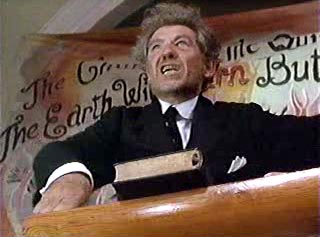
Pictured is our own Sir Ian McKellen as Amos Starkadder,-- "Ye're all damned!" -- one of the mad Starkadders at Cold Comfort Farm. Amos is a preacher for the Church of the Quivering Brethren, and it is this that made me think of the book and the film as a suggestion for further, fun reading. Poor Jeanette's Mother would be right at home among the Quivering Brethren, though I don't doubt she'd soon give them a good reason of her own for all that carrying on in Church.
Check it out.
Wednesday, February 4, 2009
Mrs. Beeton: Everything Proper
If Nell Gwynn is the spirit and symbol of Restoration disorder; sensual, bawdy, bright and buxom,the Queen of the English counter-reformation, then Mrs. Beeton is the Victorian Lady Triumphant, the ne plus ultra of the Puritan counter-counter-reformation. She wrote the manual for housewives that taught generations of bourgeois women not only how and what to cook, but how to clean, hire and fire servants, raise "proper" children, serve God and be (wait for it) respectable.
There was a fun BBC TV movie shown on PBS last year (?) about this lady, "The Secret Life of Mrs. Beeton." It's available to rent.
There is also a very thorough biography (would she want any other kind?) called The Short Life and Long Times of Mrs. Beeton, by Kathryn Hughes, though it is sadly only available in a British edition. (Look for used copies on www.abebooks.com.)
Subscribe to:
Comments (Atom)